The Sound of Silence
Letters From The Potting Shed
Issue 003: ©Matthew W. Hall September 2026

Head of Mobile Operations in full Listening Mode.
We went away for a couple of nights in the Barney Bus and found silence. Not actual silence, of course. That would have been almost impossible.
We were staying on a small campsite on a working sheep farm in the Meon Valley, surrounded by fields, hedgerows, trees, livestock and birds. There were sheep calling across the valley, cattle somewhere beyond them, cockerels announcing each new day as if nobody else had noticed it had arrived, and birdsong that seemed to operate a twenty-four-hour rota.
After dark, the owls took over.
So no, it wasn’t silent.
And yet it felt quieter than almost anywhere I had been for some time.
Barney seemed to notice it too.
As Head of Mobile Operations, he had already conducted the necessary perimeter patrols, inspected the local wildlife and established that the nearby sheep were worthy of very close attention. New creatures tend to produce a peculiar response in him. Goats, sheep and, on this occasion, a pheasant at the edge of a field can send him into a curious little bowing dance, as though he is trying to establish whether they might be interested in becoming friends.
Their response is often rather less enthusiastic.
Once operational matters had been dealt with, however, he would simply sit outside the van and listen.
It struck me that this was probably a reasonable thing for the humans to do as well.
We talk a lot about wanting peace and quiet, usually meaning that we would like everything around us to stop making noise.
Perhaps that is not quite what we are looking for.
Perhaps silence is not the absence of sound.
Perhaps it is the absence of unnecessary noise.
There is a difference.
Most of us spend a great deal of time inside a manufactured soundscape. Traffic. Engines. Notifications. Televisions. Phones. Machinery. Conversations. Doors. Alerts. Music. The low electrical hum of modern life. Individually, many of these things barely register. Collectively, they become the background against which we live.
We get used to it.
So used to it, perhaps, that we stop noticing what it is covering up.
Move away from it for a while and something rather surprising happens.
The world has not gone quiet.
You have simply become able to hear something else.
The birds had not suddenly begun singing because we had arrived in Hampshire.
The owls were not appearing especially for our benefit.
The sheep had not called a meeting and agreed to provide atmospheric rural sound effects for two people in a campervan and a Greek rescue hound.
Nature had never stopped speaking.
We had simply found somewhere we could hear it properly.
And it had quite a lot to say.
There is something similar about the night sky.
On our first evening, almost free from light pollution, the stars were extraordinary.
I stood looking upwards for a long time.
Again, nothing new had appeared.
Those stars had been there the night before when we were at home. They had been there while cars moved along roads, lights shone through windows and people looked at screens.
We simply could not see them in the same way.
Remove enough noise and you hear what was already there.
Remove enough artificial light and you see what was already there.
There is probably a lesson in that which reaches further than birds and stars.
The next evening I decided I would take a photograph of the night sky for this letter.
It would be perfect, I thought.
A second image to sit alongside these thoughts about all the things that remain present even when we stop noticing them.
Except the sky had other ideas.
Cloud had moved in and the moment had gone.
The photographs were disappointing.
Or at least I thought they were at first.
Then I realised they had probably given me something more useful than the photograph I had planned.
Tomorrow may have a different sky.
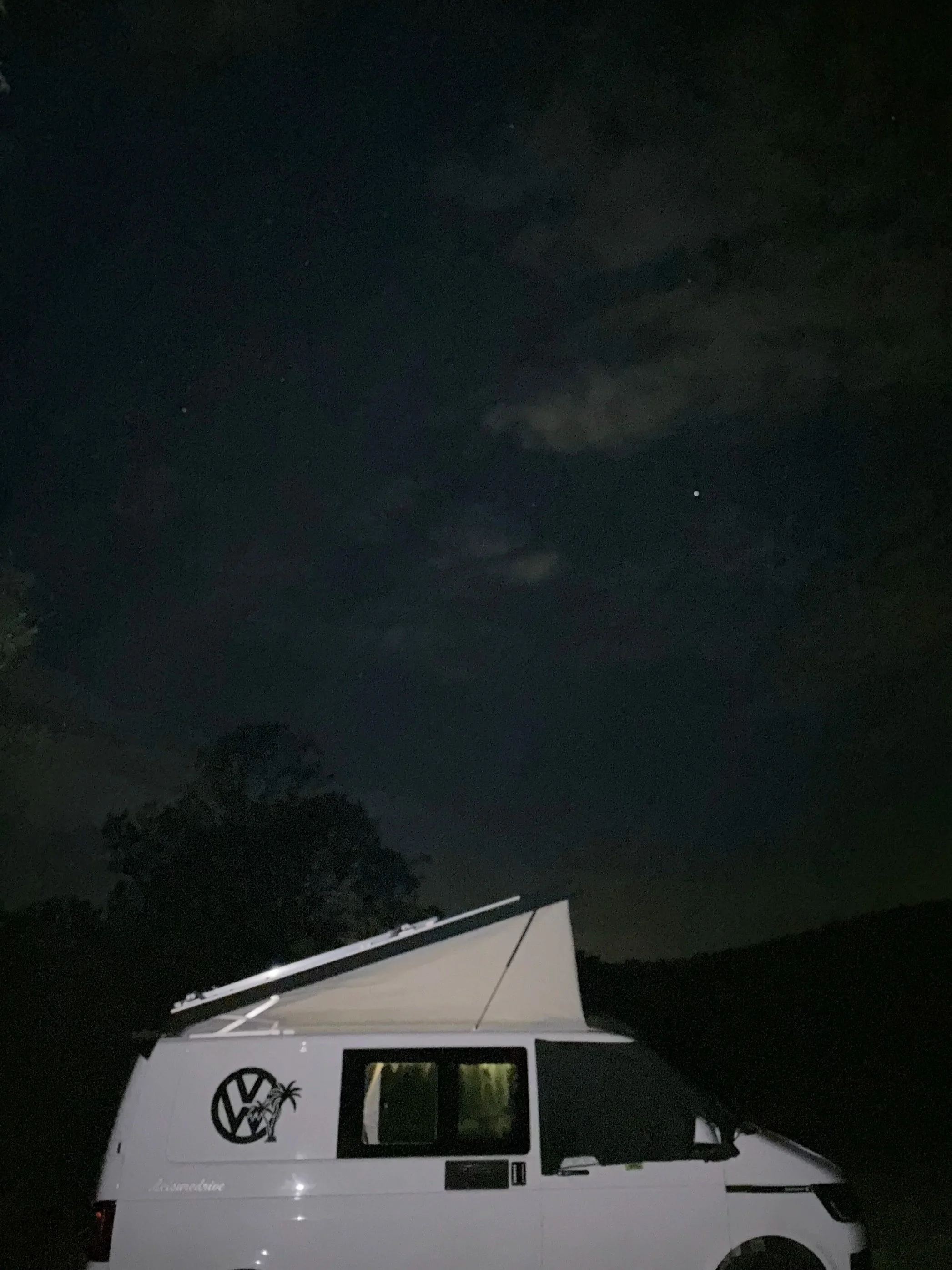
Notice Today; Tomorrow May Be A Different Sky.
We are very good at assuming we can return to things.
I will take the photograph tomorrow.
I will stop and look properly next time.
I will make that call later.
I will write that thought down when I get home.
Sometimes we can.
Sometimes the owl has moved, the light has changed, the clouds have arrived or the thought has disappeared.
Noticing is not something we can always postpone.
The moment occasionally asks something of us while it is happening.
That does not mean frantically photographing everything or turning every experience into material.
Quite the opposite.
Sometimes it simply means being there long enough to realise that something worth noticing is happening at all.
This little trip was never intended as research.
We were not heading into the Meon Valley on some grand literary expedition.
The plan was much simpler.
A couple of nights away.
Some walking.
Good food.
Coffee.
A change of scenery.
Time outside.
Barney being Barney.
The Barney Bus performed wonderfully. Head of Mobile Operations gave all key procedures a thorough shakedown. The humans provided accommodation, fuel, food, drink and access to the countryside.
All systems appeared satisfactory.
And yet, almost without trying, the place began handing over material.
A ridge walk offered a thought for a future mystery.
An ancient English village and lunch in an old pub somehow produced another.
The landscape itself began suggesting atmosphere.
A sheep farm produced a letter about silence.
This is one of the things I increasingly enjoy about writing.
You do not always know what you are looking for.
Often it is better if you don’t.
You walk.
You drink coffee.
You sit somewhere unfamiliar.
You listen.
You notice.
And occasionally something that seemed insignificant at the time finds its place later.
A sound.
A line.
A landscape.
A peculiar dog dance at the edge of a field.
A sky you forgot to photograph.
They all go into the seed catalogue.
Some will germinate immediately.
Others may sit quietly for months or years before finding the right patch of earth.
Nothing has to be forced.
Perhaps that is true beyond writing too.
We often imagine that finding stillness requires us to stop completely.
I am not sure it does.
Sometimes stillness can be found in movement.
Drive somewhere different.
Walk another path.
Sit beneath another tree.
Change the place from which you are looking.
A campervan has become unexpectedly useful for that.
It gives us enough comfort to go somewhere else without taking everything with us.
A kettle.
A notebook.
A dog.
Somewhere to sleep.
Not much more is required.
It turns out that a small change in environment can make a surprisingly large change in attention.
You hear differently.
You look differently.
You slow down without particularly deciding to.
And things that have been there all along begin to reappear.
By the time we packed up to leave the farm, nothing dramatic had happened.
No grand revelation.
No life-changing epiphany.
Just a few days in a valley that had carried on doing what it had presumably been doing long before we arrived.
Birds sang.
Sheep called.
Owls hooted through the darkness.
Stars appeared when the sky allowed them.
Morning arrived to the enthusiastic commentary of a cockerel.
And somewhere amongst all of that, life felt a little quieter.
Perhaps when we say we want to escape the noise, what we really mean is that we want to hear something else.
The natural world does not necessarily need us to discover it.
It may simply need us to stop drowning it out.
The birds are already singing.
The owls are already calling.
The stars are already there.
Sometimes we just need a slightly different place from which to notice them.
And when we do?
It might be worth looking properly.
Tomorrow may have a different sky.
Stay curious
Keep noticing
Until the next time
🌱🐾☕️📚🚐✨
